




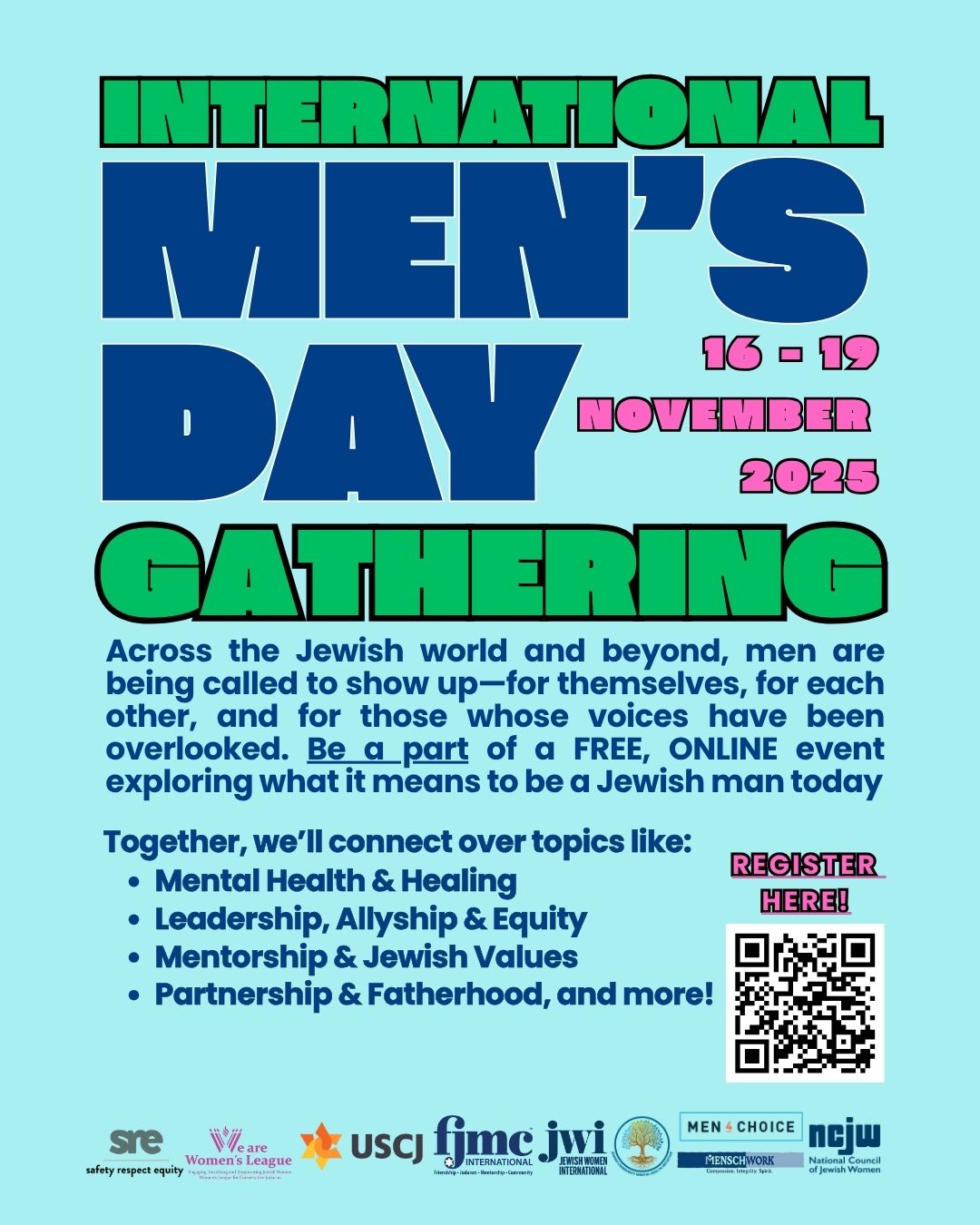
This session focused on discussing the meaning of masculinity in the context of Jewish men, particularly in light of recent global events and societal changes. The panelists – including Meredith Jacobs, CEO of Jewish Women International; Rabbi Shawn Zevitt, founder of Menschwork; FJMC Seaboard Region Executive Vice President Johnny Parker and FJMC President Bruce Tomar – explored various aspects of masculinity, including the impact of the MeToo movement, the challenges faced by young men and the importance of emotional labor and domestic responsibilities.
They emphasized the need to redefine masculinity in a positive and healthy way, while also acknowledging the influence of different cultural and religious models. The discussion highlighted the importance of community, mentorship and personal growth for Jewish men.
Zevit discussed the importance of intergenerational responsibility and masculinity, emphasizing the need for Jewish men to take active roles in their communities. Parker shared his personal journey of embracing Judaism and his experiences as a father, entrepreneur and military officer, highlighting the value of showing up and being present in both personal and communal contexts. Both speakers emphasized the significance of continuous growth, learning, and involvement in Jewish practices and community life.
The group addressed the theme of “showing up” for each other, particularly among men. Parker shared his perspective on generational differences and the challenges faced by younger generations in terms of cost of living and lifestyle choices. Zevit explored the spiritual and ritual aspects of “showing up,” including the concept of rising up in prayer and taking a stand for values.
The discussion touched on the importance of understanding and supporting each other across different cultural and generational backgrounds, as well as the need for men to seek resources for their physical, emotional and spiritual well being.
The meeting focused on the role of men in Jewish communities and society, with discussions on leadership, allyship and mentorship. Participants explored how men can show up for each other and support women as partners and allies. The conversation highlighted the importance of modeling respectful behavior and creating inclusive spaces for all community members. The conversation ended with an announcement of upcoming events and a call for participants to reflect on their own experiences and values as men.
The meeting began with introductions and setup for a discussion on mental health for men, featuring Tara Lieberman, founder of the Jewish Community Mental Health Initiative; FJMC Executive Vice President Gary Katz; and David McCarty-Caplan, a researcher and educator. Raucher outlined the format, emphasizing a casual and free-flowing conversation, and mentioned the recorded session would be shared as an FJMC resource.
The group discussed the importance of supporting men’s mental health, addressing themes like online influences, isolation, and the impact of media figures like Scott Galloway and Roy Wood, Jr. The conversation focused on how the Jewish community can best support men’s needs, with participants encouraged to share their thoughts and life experiences.
Raucher welcomed participants to the second session of International Men’s Day, reviewing the previous day’s discussion and introducing upcoming programs. He announced a Rest and Reflect Weekend for Men in March 2026, offering a discounted rate for Jewish men aged 21-65 to attend a retreat in California. The session concluded with an introduction to McCarty-Caplan, who would contribute to the day’s conversation on supportive services for men in the Jewish community.
The meeting featured a discussion on providing supportive services for men in the Jewish community, addressing their isolation and vulnerability. Lieberman highlighted the need to address multi-layered trauma post-October 7th, leading to the creation of virtual support groups for Jews worldwide, which have facilitated more than 2,000 individual sessions.
Katz, a university professor in California, emphasized the importance of engaging faculty and staff on university campuses to combat antisemitism and isolation. The panelists discussed practical ways to offer supportive services and the role of the Jewish community in combating isolation, particularly in the context of increased digital engagement and AI companionship.
This discussion focused on creating supportive spaces for Jewish men to process trauma and build community. Lieberman shared that their organization developed a weekly affinity group for Jewish men to address the underrepresentation of men in their support groups. McCarty-Caplan emphasized the importance of building community among Jewish men and suggested that making spaces less intimidating and more communal could encourage participation. The conversation also touched on the challenges faced by men of different racial and ethnic backgrounds within Jewish communities, highlighting the need for inclusive and affirming spaces for all Jewish men.
The panel discussed mental health care in Jewish communities, focusing on challenges men face in seeking help and the importance of creating safe spaces for them to share their experiences. Katz shared FJMC’s “Hearing Men’s Voices” initiative, which encourages Jewish men to engage in open discussions about their concerns. Lieberman emphasized the value of men’s contributions to group therapy, highlighting how their insights enrich the community. The panel also explored how cultural expectations, such as the “John Wayne Syndrome” and the emphasis on debate in Judaism, can hinder men’s emotional vulnerability and connectivity. McCarty-Caplan suggested that younger generations of Jewish men may approach these challenges differently, and he called for a re-evaluation of how Jewish values can both help/hinder men’s emotional well-being.
The panel discussed challenges in Jewish masculine identity, particularly around vulnerability and emotional expression. McCarty-Caplan shared his personal struggle to connect with his children without debating, while Katz emphasized the importance of replacing “rusty armor” of generational trauma with constructive engagement. Lieberman highlighted the strength in experiencing uncomfortable feelings, and McCarty-Caplan suggested reframing vulnerability as a form of courage that could strengthen Jewish communal connections.
The discussion concluded with Raucher exploring how recent historical events, including the rise of anti-Semitism and prolonged Israel wars, have impacted Jewish men’s psychosocial experiences.
The group discussed the importance of embracing complexity and diversity within the community, with Lieberman emphasizing the need to honor multiple identities and experiences. Katz highlighted the impact of traumatic invalidation on young men, particularly regarding their Jewish identity, while McCarty-Caplan explored the tension between authenticity and relationships, and the value of diverse perspectives in Jewish communities.
The discussion concluded with Raucher referencing a Talmudic story to illustrate the fragility and potential of relationships formed across differences. A practical question about the vulnerability of men in raising their children was posed, but the group did not reach a definitive conclusion because of time constraints.
The panelists discussed the importance of resilience in parenting and the bidirectional influence between parents and children. They shared personal experiences and professional insights on supporting mental health and fostering strong connections.
The group also explored ways to offer support to individuals in need, emphasizing the power of vulnerability and open communication. The conversation ended with an invitation to participate in upcoming events and a challenge to practice self-care and reach out to loved ones.
The meeting introduced participants to an ongoing series of discussions on men’s roles and partnerships, with a focus on Jewish men’s evolving responsibilities at home and in society. Raucher outlined the event’s structure, emphasizing the importance of creating a supportive and conversational tone, and introduced the key question: “What does it mean to show up as a partner today?”
The meeting began with a conversation about men’s leadership and vulnerability, followed by discussions on mental health with three doctors, and concluded with an impromptu men’s support group. The event continued with a panel discussion on being a supportive male partner, featuring Oren Jacobson, a civic entrepreneur and founder of Mens4Choice, and Rabbi Ellen Wolintz Fields, the executive director of Women’s League for Conservative Judaism. Also participating was Rabbi Oliver Joseph, Jewish chaplain at Canary Wharf in London, and Rabbi Ari Y. Saks of Temple Torat Yisrael.
Jacobson and Fields were set to lead the discussion, with additional rabbis potentially joining later. The conversation explored how Jewish men can support their partners in various relationships, addressing issues of domestic labor, women’s rights and bodily autonomy.
Additionally, Raucher announced an upcoming Rest and Reflect Weekend for Men in March, inviting participants to register by Feb. 15, 2026.
The meeting explored the concept of partnership, with Fields, Saks and Jacobson sharing their perspectives. Fields emphasized the importance of being a mensch, practicing respect, and maintaining honesty in all relationships.
Saks, who recently transitioned from a pulpit rabbi role to focusing on interfaith families and online education, discussed his current work and the values he upholds in partnerships. The conversation aimed to foster an open dialogue about the nature of partnerships, with an emphasis on shared values and mutual respect.
Jacobson shared his perspective on partnership, emphasizing the importance of understanding and meeting each partner’s needs rather than adhering to a 50-50 split. He discussed his experience as a solo dad and highlighted the need for flexibility in partnerships, especially in balancing professional and personal responsibilities. Raucher appreciated Jacobson’s secular perspective and agreed that equity in relationships can take various forms, emphasizing the importance of communication and understanding in partnerships.
Saks discussed the challenges and opportunities in interfaith families, particularly focusing on the role of Jewish fathers. He shared examples of how both parents can contribute to their child’s cultural and religious upbringing, emphasizing the importance of equity and partnership. Saks highlighted the need for rabbis to create space for both partners to share their heritage, and suggested that Jewish tradition should evolve to recognize the father’s role more fully.
Joseph, founder of a small community in London, discussed the challenges and dynamics of partnerships in European Jewish families. He highlighted the strain on relationships due to financial concerns, safety issues and evolving family structures, while emphasizing the importance of communication and community support.
Joseph noted that good communication skills, learned through his youth movement, have helped him and his wife navigate their roles and responsibilities better than previous generations. He also expressed hope in the power of community to support each other, especially in times of strife, and stressed the need for sharing best practices in family life to improve partnerships.
Panelists addressed gender roles and traditions in Judaism, with Rabbi Ari highlighting the historical shift from patrilineal to matrilineal descent and emphasizing the need to treat sons and daughters equally. Oliver raised concerns about the dangers of extreme gender equality, suggesting that clear boundaries are necessary to prevent radicalization. Oren shared insights from his work on reproductive rights, noting that men often lack awareness of their stake in these issues and the importance of creating spaces for men to engage in — Workplace Allyship & Equity Discussions.
Raucher welcomed the panelists – Rabba Daphne Lazar-Price, executive director of Jewish Orthodox Feminist Alliance; FJMC Inclusion Committee Chair Jerry Brodsky; and Rachel Gildiner, a gender equity advocate and Executive Director of the Safety, Respect, Equity(SRE) Network – and provided context for the conversation, which follows previous discussions on mental health and Jewish community services. The panelists were set to explore workplace allyship and equity, with Raucher emphasizing a focus on free-flowing dialogue and prepared questions as a backup if needed. The session aimed to continue the broader conversation on allyship and equity in the workplace, building on previous discussions.
The meeting focused on International Men’s Day events and conversations, with discussions on various topics including mental health, Jewish partnerships and workplace allyship. FJMC Vice President Bob Watts was thanked for his technical support in broadcasting the events. The conversation continued with a focus on allyship and inclusion in the workplace, particularly for Jewish men, with Gildiner introduced as a key speaker.
The panel discussed allyship, inclusion and equity in the workplace. Gildiner emphasized that allyship is an active process, not a static identity, and highlighted its importance for marginalized groups’ success. She noted that male allies can significantly impact women’s confidence and career advancement. The panelists discussed the need for ongoing learning/action in allyship, acknowledging that perfection is not required.
Gildiner and Lazar-Price discussed gender equity in religious communities, emphasizing the importance of allyship as a proactive and conscious effort. They highlighted the need to challenge cultural norms and patriarchal assumptions, educate oneself without burdening women and amplify women’s voices in leadership and scholarship. Lazar-Price stressed the importance of being in positions of power to make inclusive decisions and model respectful behavior, while Raucher agreed on the significance of awareness and challenging assumptions in addressing gender issues.
Panelists discussed the importance of healthy masculinity and creating spaces for men to explore vulnerability and accountability. Gildiner emphasized the need to address healthy masculinity in conversations about gender equity, and highlighted the lack of spaces that encourage men to be emotionally open.
Lazar-Price shared her experience of fostering open conversations at Shabbat gatherings, suggesting that such settings can provide a safe environment for men to discuss personal and professional challenges. The discussion underscored the value of creating inclusive spaces where men feel supported to engage in deeper conversations about gender, vulnerability, and leadership.
Brodsky discussed the concept of genuine allyship for men, using a personal example from a recent event. He noted that men often engage in shallow conversations and need an excuse to delve deeper. Brodsky emphasized the value of creating spaces for men to share personal experiences and challenges, highlighting the importance of Jewish allyship in fostering meaningful connections and conversations among men.
The panelists discussed the importance of healthy masculinity and creating spaces for men to explore vulnerability and accountability. Gildiner emphasized the need to address healthy masculinity in conversations about gender equity and highlighted the lack of spaces that encourage men to be emotionally open.
Lazar-Price shared her experience of fostering open conversations at Shabbat gatherings, suggesting that such settings can provide a safe environment for men to discuss personal and professional challenges. The discussion underscored the value of creating inclusive spaces where men feel supported to engage in deeper conversations about gender, vulnerability, and leadership.
Brodsky discussed the challenges of embracing new masculinity definitions and the need for men to actively listen and empathize, particularly in inclusive situations. He highlighted the difficulty of natural interactions with people who are different, such as those in wheelchairs or with autism, and emphasized the importance of training to overcome these discomforts.
Lazar-Price suggested a practical approach to fostering inclusivity by encouraging men to become synagogue greeters, which would help them welcome diverse individuals while ensuring safety. Raucher raised concerns about the portrayal of men as unaware of cultural changes, referencing high-profile cases of men exploiting power and authority, and stressed the need for men to actively engage in addressing these issues rather than remaining on the sidelines.
The group discussed accountability and the role of shame in preventing progress, with Gildiner emphasizing that viewing mistakes as learning experiences rather than sources of shame can empower continued involvement in social justice work. Brodsky noted that the inclusion initiative had given members permission to support marginalized Jewish men, while Gildiner highlighted the importance of balancing awareness with specific actions to cultivate both personal and communal understanding.
Lazar-Price discussed her mission to advocate for women’s equality within Orthodox Jewish communities, emphasizing the importance of women’s presence at decision-making tables. Brodsky shared insights on the current state of masculinity, comparing it to an ongoing metamorphosis. Raucher asked Lazar-Price about the limits and possibilities of male allyship in traditional communities, to which she responded with examples of modern Orthodox synagogues making progress in inclusivity while often preferring to keep their efforts under the radar.
The meeting focused on organizational culture shift and allyship in Jewish institutions. Gildiner shared statistics and resources on the importance of male allyship, including how it can reduce women’s likelihood of leaving jobs and improve their performance. Jerry discussed challenges and opportunities in FJMC, including overcoming resistance from some members and avoiding tokenism in leadership positions.
The panelists were asked to share Jewish stories or teachings that ground their understanding of equity and justice, with Lazar-Price, Gildiner, and Brodsky each offering different insights. The conversation ended with Raucher expressing appreciation for the panelists’ contributions.
The meeting covered the availability and accessibility of recorded sessions from recent International Men’s Day (IMD) events. Bob confirmed the sessions are available on YouTube, Facebook, and a dedicated page on the FJMC website, with new recordings being processed daily.
This article was prepared using AI assistance.
Need technical or website help? Email us at
Copyright © 2026 FJMC International. All rights reserved. Website designed by Addicott Web. | Privacy Policy