
Why Am I SO STRESSED?

Why Am I SO STRESSED?

by Gary S. Katz, Ph.D.
FJMC International Executive Vice President

Your sleep has grown a little wonky; your appetite has either increased or decreased a noteworthy amount; small things that used to not bother you now are incredibly irritating, and you find yourself at odds with some of people in your life.

What’s going wrong?

Life as a Jewish man in the past 18 months has not been easy. On top of the stress of the October 7th massacre and the more than two years of chaos that followed and the recent US/Israel war with Iran, we have all experienced growing economic uncertainty, political stress in an increasingly divided world, and a near constant thrum of antisemitism.

“But Jews have always been attacked, right? And we chant ‘Am Yisrael Chai!’ and move on…” some say. True. But: seismic increases in antisemitic attacks across North America in the past two years? University and K-12 campuses rife with antisemitic screed and protests?

These are unprecedented times. And, on top of these immediate stressors, there has also been an insidious rise in those who promote falsehoods about Israel and attack Jews’ attempts to promote accuracy and reporting in the popular media. It is this second area
of stress that I want to talk about here.

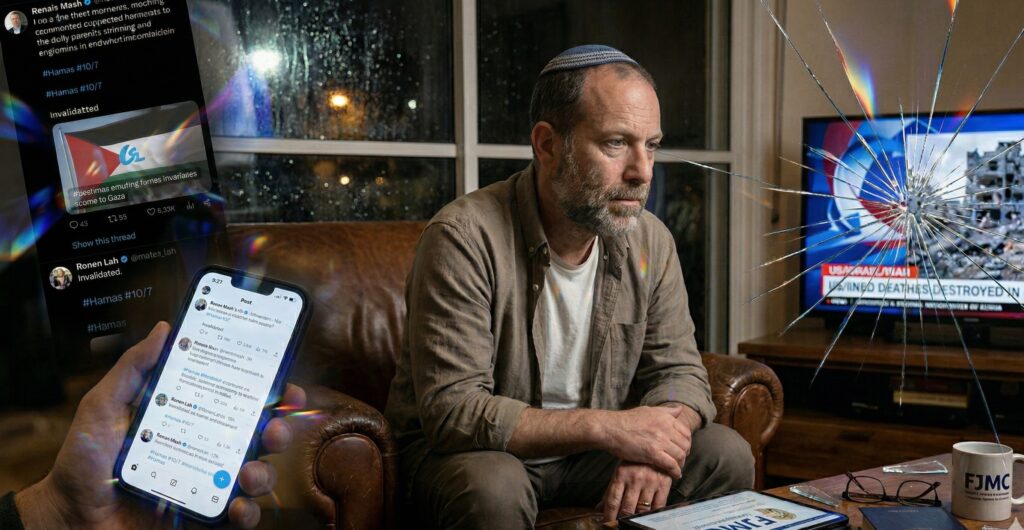
Traumatic Invalidation, a concept studied by my dear friend and colleague, Dr. Miri Bar-Halpern of Harvard University, refers to “the ignoring, denial, or minimalization of emotional pain” specifically in how it impacts the Jewish community following the 10/7 tragedy. According to Dr. Bar-Halpern, “rather than being met with compassion and care, many individuals instead encountered emotional neglect, criticism, blame, and even outright denial of their pain” in the months following the Hamas terrorist attack on Israel. This results in a range of negative impacts to Jews including questioning one’s self-perception, their ability to regulate and control their emotions, and their general view of the world. While the 10/7 terrorist attack itself caused great harm to Jews abroad, it was the silence of friends and colleagues, the spurious blaming of Jews for the attack on 10/7, the exclusion of Jews from college campuses and other workplaces, and the outright denial of the events of 10/7 that cause additional harm. For Jewish men, these concerns created additional pressure points related to our roles as protectors, defenders, and wage-earners, while at the same time impacting are vulnerabilities associated with emotional communication and expression. It is hard enough to be a Jewish man who is expected to keep his family safe. For some, it is hard to simply exist as a publicly Jewish man. For others, it is hard to be a Jewish man and want to do something with the range of gut-wrenching emotions that have followed in the wake of the 10/7/23 and more recently US/Israel war with Iran. If you have been feeling a bit more stressed, this might explain why these nights are different from other nights.

So, how can a Jewish man stand these times and live? There are many things at our
disposal. If you are experiencing more significant symptoms – those which interfere with your ability to enjoy life and be productive in your work or hobbies or interpersonal relationships, it may be beneficial to seek out a professional, who can help you work through these concerns in a more adaptive way or, in more severe cases, assist with a
trial of medication.

For many folks, one of the most effective interventions for traumatic invalidation and the stress associated with these concerns is to find a community for support. That is also one of the key strengths of FJMC International – in our entire panoply of initiatives, there are support groups, webinars, and other peer resources at your disposal. Check your news consumption habits and consider taking programmed “breaks” from news feeds, television and radio news programs. Research has shown that even passively consuming media such as this can produce physiological changes in your body: increased heart rate, blood pressure, and stress hormone production. If you are really wanting to increase your heart rate in a healthier way, try taking a walk – outside, preferably and if the climate accommodates – since sunlight is a great reducer of stress and anxiety. Regular exercise, 30 minutes of cardiovascular exercise at a level of intensity where it would be difficult to have a conversation, for a minimum of three days a week has also been shown to have a significant effect on anxiety, stress, and depression. Find a hobby, something that you enjoy doing, ideally. And if you can join a group of folks that have similar interests (say, one of our FJMC International Affinity Groups?) even better.

I hope that just learning a bit about traumatic invalidation and its impact on Jewish men will help many of us sleep a bit better and understand why we may feel particularly stressed these past few years. I am optimistic that if you try one of the suggestions I’ve documented to cope with these stressors that you will feel a bit better. Nonetheless, if you have any questions about what you’ve read, I’d love to hear from you.
You can reach Gary Katz here: