




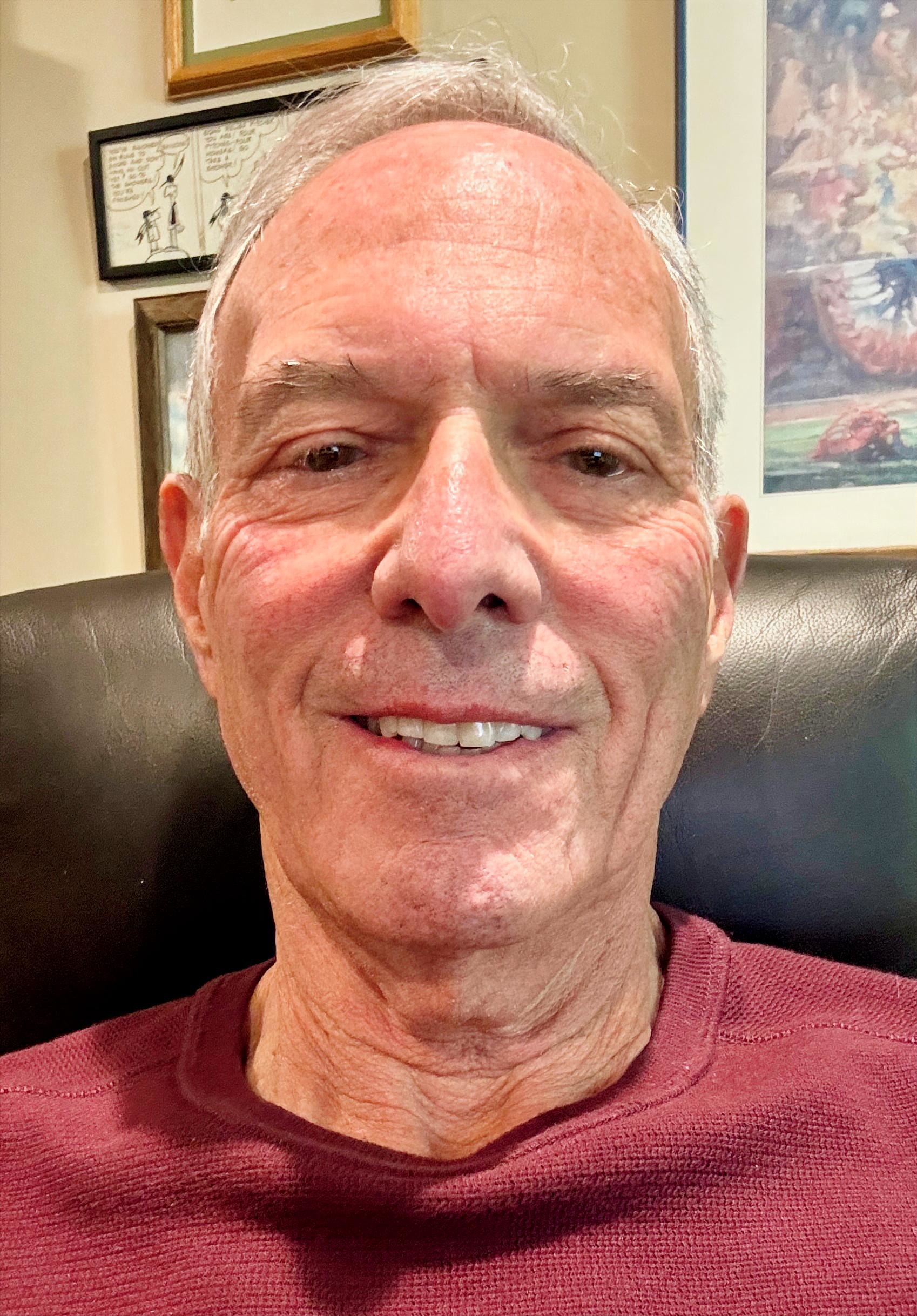
By Stan Schnitzer
Editors’ Note: Stan and Judi Schnitzer were in Jordan and Egypt when war with Iran broke out. Stan shares his reflections on getting out of Egypt under duress a month before Pesach.
History and the present collided for us as the war with Iran broke out. Judi and I were on a tour of Jordan and Egypt that was supposed to run from Feb. 27 through March 20. By March 3, however, we knew our trip would be curtailed and that by March 6, we’d be back in Atlanta.
We lost a cruise on the Nile, but we got to see a number of places that relate to the Exodus and Pesach, including Mt. Nebo (or what they think might be Mt. Nebo), the dry bed of the Arnon River (where Moses was unable to negotiate passage north through Moab) and the Pyramids and Sphinx, which are symbolic of Egypt, where we were enslaved.
I must say at the outset that as part of a 19-member guided tour, we never felt like we were in great danger. Yes, we heard sirens while in Jordan and heard roars overhead, but we never saw anything. Still, it was surreal – and enlightening.
By the time we boarded our bus in Amman on Sunday morning, March 1, we knew that war had broken out. We were on our way to Jerash, a city 30 miles north of Amman known for its well-preserved Greco-Roman ruins that date back over 6,500 years. Our guide, Kaled, assured us we were safe, telling us that he is required to check in with the Jordanian Ministry of Tourism for a safety update. We also had an armed policeman from the ministry with us.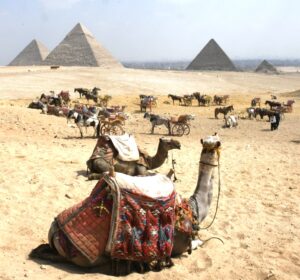
Kaled said that he was personally glad that Iran was under attack. He said Iran’s leadership ruined the region and grossly misrepresented what Islam is supposed to be. He lamented that once upon a time, it had been possible to drive from Amman to Beirut or Damascus to have lunch with family and friends and then return home.
At the same time, as we drove through the arid suburbs of Amman, which were sprouting housing and urban development instead of fruits and vegetables, he talked about how the Ottomans had deforested the land and how Jordan and Israel were cooperating on meeting Amman’s water needs. The region now has 12 million residents.
Kaled already knew we were Jewish. As we toured the Citadel and then the Coliseum and market in downtown Amman the previous day, I mentioned I had been there 47 years earlier, taking time from a kibbutz to chase down a business story as a freelance writer – a trip my kibbutzniks encouraged me to take. We talked about what I thought I remembered from the Coliseum, Jerash and Petra, and he helped me find the Philadelphia Hotel next to the Coliseum where I had stayed.
By dinner time Sunday night, concern was growing for our safety, with one couple insisting on leaving. They were persuaded by Kaled and several of us to stay with the group and go to Petra the next morning as scheduled.
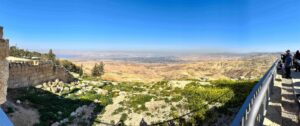
For me, the trip to Petra is where I started to think more about our trip’s relationship with Pesach. We traced the Exodus backward, starting with a visit to what may be Mt. Nebo, which is where Moses viewed Canaan, the land he would not enter. Facing west, we could look southwest and see the Dead Sea. Shifting our gaze northward, we could see the Jordan River and Jericho – where the Israelites would cross into the Promised Land. You can see the lights of Jerusalem at night. How awesome is that?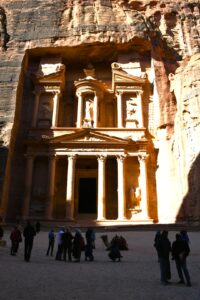
Our ride to Petra was on the Kings Highway, which long, long ago linked Africa with Mesopotamia, running from Egypt through the Sinai Peninsula to Aqaba, and then northward across Transjordan to Damascus. Our people may have been in the wilderness for 40 years, but they weren’t wandering off the beaten path.
We arrived at Petra just before sundown and got a sense of its long history at the city’s museum. The next morning, we walked down the steep-walled canyon, a trek I made 47 years ago on my own and one that Judi and I were supposed to make nearly four years ago. I hadn’t remembered breaks in the canyon, where we could see dwellings and riverbeds that fed the water collections system engineered by the Nabataeans, a nomadic Arab people who settled in the region around the 4th century BCE.
But I remembered the Treasury Building, made famous in Raiders of the Lost Ark. It was still as magnificent as it was when I saw it before the movie was made, and it was our tourism pilgrimage. Much more was open than when I had been there, of course, and we saw all the signs of what a bustling city there had been.
Of course, the present jolted us when we heard air-raid sirens and jets roaring overhead. It was our reminder we were probably best off by getting to Cairo the next day so we could fly home the evening after that.
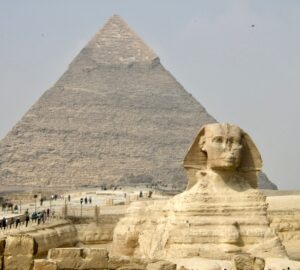 After an uneventful flight to Cairo, we got a pleasant surprise. Our guide, Marco, said our tour company arranged to take us to the Pyramids and the Sphinx early the next morning and then to the newly opened Grand Egyptian Museum.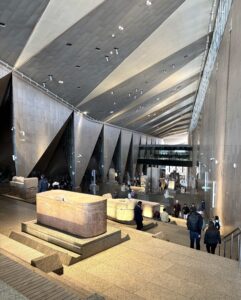
The symbolism was vivid to me. Even though slaves did not build those Pyramids, they are symbolic of our ancestors’ slavery. They are also massive, magnificent structures – tombs connected by interior hallways. Some of the building blocks are so big that one can only marvel at the strength of the people who put them in place. One point of interest is that the Nile flowed much closer to the Pyramids back in those days, and we could see the remains of a port. The nearby Sphinx, which guards the Pyramids, is a remarkable work of art.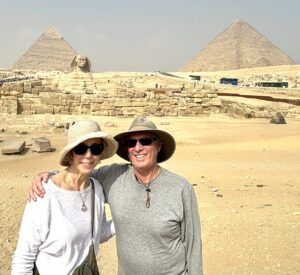
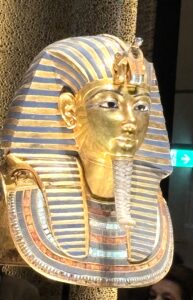
After lunch, we went to the Grand Egyptian Museum, completed last November at a cost of $2 billion. Marco said we could spend two months there, but he was going to show us what he thought were the most important exhibits in a half-day sprint. Our tour focused on King Tut’s tomb and the more than 5,000 artifacts recovered from it, including miniature guards and lunchboxes. We also saw the priceless King Tut mask. It is a truly spectacular museum. Egypt is rich in history.
 After showers and dinner, it was time to board another bus for a ride to the airport and a charter flight that would take us to Madrid for fuel stop (nearly 300 people couldn’t get off the plane) and then to JFK in New York, where we checked in for flights home. Just like the Israelites, we did not have a direct route home.
I couldn’t help but recall some similarities to the Exodus:
We packed a lot into a week. Judi and I are grateful we got to see many of the places we had been looking forward to and that we got home safely – despite inconveniences. When we sit around the seder table and continue to listen to weekly Torah readings, we’ll have our own story of going down to Egypt, experiencing the country ever so briefly and leaving in a great hurry.
Stan Schnitzer is a contributor to HaD’var.
Need technical or website help? Email us at
Copyright © 2026 FJMC International. All rights reserved. Website designed by Addicott Web. | Privacy Policy