




By Norwin Merens
Juneteenth is the holiday that recognizes when Union troops delivered the Emancipation Proclamation to the last known groups of enslaved people in Galveston, Texas. Celebrations have been a cultural moniker in Black communities since the first events in 1865 at the end of the American Civil War.
But, in 2020, cries of racial justice and inequality prompted legislation that fortified Juneteenth (June 19) as a federal holiday, for all Americans to celebrate a milestone event in Black American history.
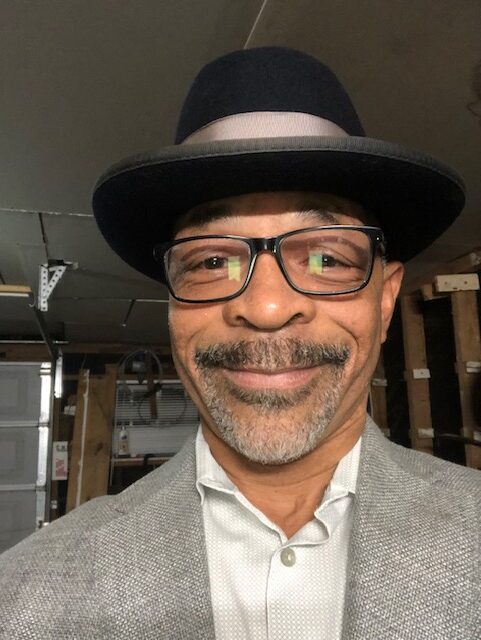
With Juneteenth celebrations coming up this month, we asked FJMC International leader Johnny Lee Parker, currently the executive vice president of the Seaboard Region, for his own perspectives on both his own Jewish journey and what Juneteenth symbolizes for him.
Parker was born in New Orleans, but raised in the small town of Covington, La., about 45 minutes north of the “Big Easy.” He is the eldest of four siblings, with two brothers and a sister. He attended The St. Paul’s School, a Christian Brothers school in Covington. While there, he was awarded a full scholarship to Southern University, in Baton Rouge. Parker played multiple instruments in high school; however, his scholarship was for the tuba. But rather than entering college upon his high school graduation, he enlisted in the U.S. Navy.
 He was trained in the Navy as an aviation machinist mate, which is a jet engine and propeller system mechanic. While on active duty in Norfolk, Va., he attended college full-time and received his bachelor’s degree. Parker spent the next eight years in the Navy before deciding on a career change. At age 26, he entered the real estate business as a sales agent in Virginia Beach.
It was there he met his wife, Susan Longman. The couple’s next wedding anniversary will mark 38 years together. They have four sons and three grandsons. The couple also owns several real estate entities: a brokerage, a property management firm and a building company. Parker also has a real estate instructor’s license.
 Parker’s wife, Susan, is Jewish and grew up in Norfolk. After their marriage, Parker began attending Shabbat services with Susan as they started their family. Despite having been raised Reform, she wanted the boys exposed to Conservative Judaism. Following weekly attendance and participation in the ritual aspects, Parker decided to go through the conversion process.
Three months following his Beit Din, he attended a lay leadership program at Camp Ramah Darom. While there, he received a deep dose of Jewish ritual and worship practices. Although new to Judaism and the Hebrew language, Parker was able to grasp the concepts because of his musical background. Since then, he’s been leading worship services, leyning Torah and handling numerous other ritual duties.
FJMC has been an integral part of Parker’s Jewish journey and personal development. He has been an active FJMC member for nearly 25 years, and now serves as the Seaboard Region’s EVP.
FJMC International: How do the themes of slavery and the journey from bondage to freedom in the Passover Haggadah improve our understanding of the African-American experience?
Johnny Lee Parker: The themes of slavery and the journey from bondage to freedom are similar since both groups experienced liberation and freedom. However, the Exodus was a religious event inspired by Hashem and led by Moses. The emancipation is an American story relating economics and politics. What we learn is that oppression is not permanent and that freedom carries both rights and responsibilities.
 FJMC – How does the Jewish concept of remembering the Exodus from Egypt shape your experience on Juneteenth (June 19)?
JLP — Pesach is my favorite festival holiday. It is officially classified as one of the three major Pilgrimage Festivals in Judaism along with Shavuot and Succot. In our family, we always have a large Seder (20-25) people and I’m the chef. The most I have learned about Juneteenth was in the last few years when President Joe Biden signed the order for the holiday. Passover is a religious requirement written in the Torah. I have not been involved in any Juneteenth celebrations, although I may after pondering the question.
FJMC – In Jewish tradition, we retell our history to ensure each generation feels as though they personally left Egypt. How do you pass down the history of emancipation to younger generations?
JLP – In my family, our communal gatherings were typically spiritually related to gatherings like Christmas and Easter. However, the biggest and most exciting communal was the annual Mardi Gras in New Orleans. It’s like Purim on steroids!
FJMC—What does “freedom” mean to you in a modern context, and how do you see that reflected in your personal or community observances?
JLP – This is a great question! I am who I am because I am free. Freedom means I have the right to all the freedoms that all legal citizens in the United States enjoy. I don’t personally feel that I lack any freedoms.
FJMC – How do different communities share space and support each other’s historical struggles for civil rights and equality without combining them?
JLP – Jews and African Americans have historically supported each other in the struggle for civil rights and social justice reforms. As minority groups, we share in the fight to defeat racism and inequality, which both Jews and African Americans have been subjected to.
FJMC – How can the concept of Tikkun Olam (repairing the world) guide our response to racial injustices?
JLP – We must recognize and accept that all men and women, regardless of race, color, creed, religious beliefs, sexual orientation and political party affiliation are made in the image of the Holy One. We must stand up to hate and oppression, however it rears its ugly head!
FJMC – How do we navigate the reality that legal emancipation did not bring true freedom? This connects the historical reality of Jim Crow to the ongoing process of systematic liberation.
JLP – We have come a long way since I attended a segregated elementary school in Covington, La., in the 1960s. Jim Crow had its grip on our nation, especially in the South. Those times and have passed and what remains are a few relics of the past. Namely, the inner city areas throughout our country where housing redlining was prevalent. The bigger issue, in my opinion, is one’s mindset of how and where you see yourself when looking in the mirror.
Norwin Merens of the Midwest Region is a HaD’Var Contributor.
Need technical or website help? Email us at
Copyright © 2026 FJMC International. All rights reserved. Website designed by Addicott Web. | Privacy Policy