




By Jonathan D. Epstein
It’s the birthplace of rock ‘n roll, and home to the Rock ‘n Roll Hall of Fame. It’s a city of sports fans, for the Browns, Guardians and Cavaliers, as well as a host of minor-league and collegiate teams for ice hockey, arena football and other sports. Its West Side Market has operated since 1912, and its Playhouse Square is the largest U.S. theatre district outside New York City.
But Cleveland is also known for having one of the most vibrant Jewish communities outside of New York and Baltimore. And within FJMC International, it’s known for the JMen.
Centered at B’nai Jeshurun Congregation in suburban Pepper Pike, Ohio, the JMen is a group of about two dozen younger Jewish guys that formed more than two years ago, at the urging of leadership within the synagogue’s men’s club.
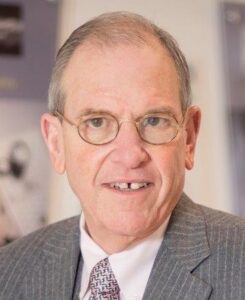
FJMC International Past President Tom Sudow
It began with club leaders brainstorming about how to engage younger men, and a comment by former FJMC International President Tom Sudow – a member of the club – about a business that wanted to grow but couldn’t change its customer base. So the company opened up a subsidiary to cater to a different clientele, without anyone realizing that it was the same company.

Jerry Brodsky
That got the wheels turning. “These guys aren’t joining their father’s age demographic to do stuff with us,” said Jerry Brodsky, a member of the club leadership who championed the idea. “So we need a new name and to convince them to hang out with each other for a couple of hours here and there.”
Brodsky, a retired school administrator, took the lead in starting the effort, but kept it separate from the club. “I told the men’s club guys that I was going to do this, but I didn’t want any of them involved,” he said.
He asked the synagogue’s clergy and office staff for a half-dozen names of younger “movers, shakers and influencers” within the congregation, contacted them, and invited them to his house one Sunday morning. And he put FJMC Executive Director Rabbi Noam Raucher on Zoom with them.
“You guys don’t realize it yet, but you want to get away from your wives and kids here and there and hang with each other,” Brodsky said he told them. “Once you do that, you’ll find it’s something you’ll want to have.”
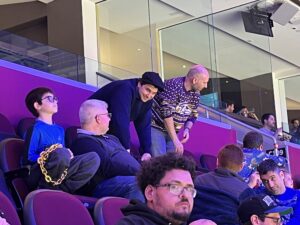
JMen and Men’s Club at a Cleveland Monsters hockey game.
For the first event, the new group settled on going to a Cleveland Guardians baseball game, getting 20 tickets.
The 244-member club offered its support, to subsidize the cost. But Brodsky went further, telling the younger guys to consider the club’s funds and resources to eventually be theirs “at some point.”
“So you’re not asking the men’s club if they’ll subsidize the ballgame,” he said. “You’re asking yourself.”
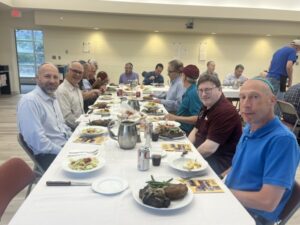
Men of all ages attend the steak dinner.
Fifteen men signed on for the game, which ended up being rained out. But “for an hour, you didn’t know, so everybody was kibbitzing,” Brodsky said. “So I walked over to the guys and said, ‘Sorry it didn’t work out.’ And they said, ‘What you do mean? This was great.’”
That was the first of multiple events for the JMen, who “discovered they did like to hang with each other,” Brodsky said. They’ve done happy hours, gone to a minor-league hockey game, and held a steak dinner at the Cleveland Schvitz social club – with 27 guys paying $150 each, for two years in a row. Some activities have been just the younger guys, but some have included their families. And planning is informal, even spontaneous, with the members splitting up the events to lead.
 “They just discovered what we know, that there’s a time to just hang with the guys every once in a while, to laugh and to talk,” Brodsky said. “They don’t need offices. They don’t need titles.”
But it’s not just fun and games; they’re getting involved with the larger club. Some of their events are open to everyone, while some are just for them. And they’re already starting to morph into something more formal.
They’ve joined the regular club members in cooking for the annual Purim carnival, and helped prepare corned beef for the annual Browns-Steelers outing. They helped distribute Yellow Candles to 804 families. And after just two years, Brodsky expects them to start to take over some of these efforts.
One of the JMen even served as a vice president of the club this past year, and one came to FJMC’s Leadership Development Institute in February. And this month the club is installing four JMen – Aaron Wolkoff, Adam Hirsh, Steve Chupnick and Mike Berman – as president, vice president, secretary and treasurer for 2026-2028 term.
“Now, every event that we do, including this election, is now JMen-run, JMen-focused,” Brodsky said. “So are they taking over the men’s club? The men’s club is becoming what we wanted, younger guys and older guys together. That’s what we’re doing in Cleveland with JMen, and it’s working. Young and old we couldn’t be more proud of our ability to work together locally, regionally and internationally.”
Jonathan Epstein is editor of HaD’Var, and a member of the Engaging Younger Men Committee.
Need technical or website help? Email us at
Copyright © 2026 FJMC International. All rights reserved. Website designed by Addicott Web. | Privacy Policy