





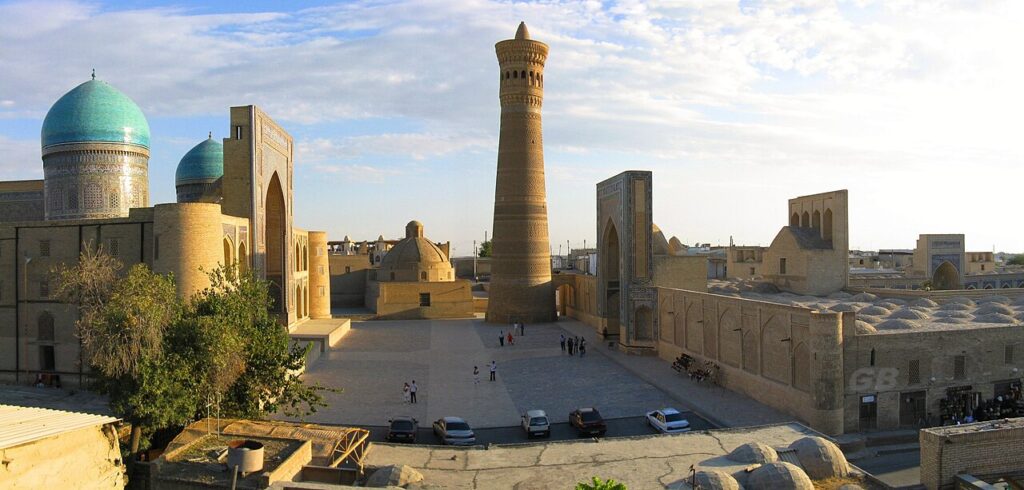
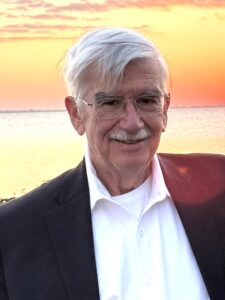
 My wife Linda and I arrived in Uzbekistan in August of 2001 to take up our posts at the U.S. Embassy in Tashkent. With us were our children, Vega, 6, and Zach, just 2. We had anticipated and read so much about the country and the civilization of the Silk Road that we were anxious to start our sightseeing. We decided to go to the ancient city of Bukhara in central Uzbekistan for Rosh Hashana in September, where there is an ancient Jewish community that now extends to Israel and the U.S. The Bukharan Jews trace their roots to the Persian Empire and may be the oldest Jewish group in Central Asia, many think descended from first diaspora/Babylonian exile Jews.
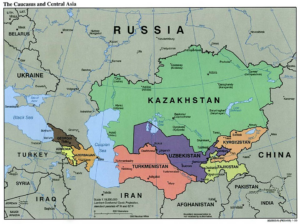
We took an overnight train from Tashkent. We had located the main synagogue in Bukhara, and we were so bold as to go there for the first time on Rosh Hashanah morning. We were nervous because in Jewish communities in South America and Europe we had experienced, newcomers were given close scrutiny and sometimes even turned away. Even in the U.S. in many congregations you could not just walk in on Rosh Hashanah morning.
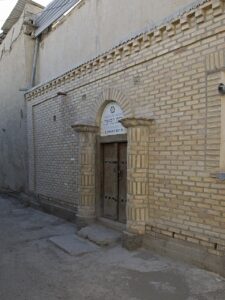
We arrived at the synagogue with two little kids in tow and clearly stuck out among people different from Ashkenazic Jews in dress, in customs, in ethnicity. The men wear the large Bukharan kipot and the women dress in colorful robes. The rabbi welcomed us heartily. Linda and the kids went to the balcony, and the rabbi brought his son from the front row to greet me. His son was visiting from Queens, where so many from the community have settled that it is referred to as “Queensistan.” He greeted me warmly and took me to the front row, and found a place for us. He guided me through the service. The mahzor was very strange, with Hebrew on the right, and Hebrew transliterated with Cyrillic characters on the left. I could kind of read both, and made it through the service.
Even more touching was that at the end of the service, the rabbi took me by the arm and led my family into the Beit Midrash. He wanted to show me their connection with the outside world, and on the wall was a portrait of the Chabad Rebbe Schneerson – Chabad provides much support for the communities of Central Asia. The Rabbi also proudly pointed out the accompanying portraits of Hillary Clinton and Madeleine Albright, who visited there in 1997 when First Lady and Secretary of State!
Rosh Hashanah 2001 was on September 17th, six days after September 11th. So by Yom Kippur, it was clear we were going to war in Afghanistan. Back in Tashkent by then, we were especially nervous about whether we would even be there for much more time, as some posts in the area were already considering evacuating. During the day of Kol Nidre, a senior Embassy officer called asking about our plans for services. The Bukharan synagogue in Tashkent was only a few blocks from our house and we were planning on going there, and were asked if we would take a few extra visiting American Jewish officials with us.
The synagogue had been burned to the ground by vandals the previous Yom Kippur and was being rebuilt, with 5 of the 8 Torah scrolls destroyed, so the service was held outdoors under a tent for the men, with women sitting farther away at picnic tables in the parking lot. We arrived with an American entourage, probably the first Americans they had seen in a while. Despite challenging conditions, we men were welcome and sat on wooden benches around the makeshift bimah, and the women sat with the very friendly local women.
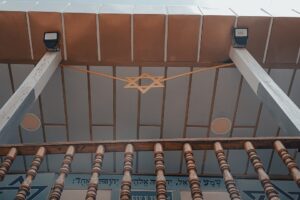 The height of the experience for me and the most memorable welcoming experience I can remember, came on Yom Kippur morning. The entourage was off working, so it was just Linda and me. The service was conducted in the new sanctuary, still under construction. The synagogue was shaping up as beautiful, with marble and chandeliers, donated by a prominent wealthy member of the community who had made aliyah, Israeli diamond magnate Lev Leviev. Linda went upstairs to the balcony, and I squeezed into a bench seat in back. Trying to make sense out of the service, I experienced the traditional auction of the aliyot, a Sephardic custom. The auction was conducted in Bukharian, an ancient language in the same vein as Yiddish and Ladino, that is a mixture of Farsi and Hebrew.
But my shock came when the last Torah reading was approaching. The young rabbi, who I didn’t think even noticed me, looked straight at me, over several rows of men, and pointed his finger at me. One of the gabaim squeezed his way back through the crowd and took me by the hand and led me up to the bimah to have the last Aliyah. I was so nervous and overwhelmed that the memory of that blessing is hazy, but I believe I made it through okay. So I walked into a congregation as a brand new, unknown Jew and had an aliyah on Yom Kippur morning!
Also touching was that I don’t think the Rabbi ever learned my given name. I saw him once in a while at the synagogue and in the street as we lived nearby, and after that first aliyah, he greeted me by my Hebrew name.
The lesson I carried home from Uzbekistan is that welcoming is not passive. It is not enough to unlock the doors and hope people find their way in. The true spirit of welcoming means noticing the stranger, reaching out to them, and offering help, and treating a newcomer, or member only there for the holidays as a blessing. We can make the Yomim Noraim truly “Days of Awe.” When our sanctuaries are fullest and many people are returning after a long absence or entering for the first time, we have the chance to make every Jew, every person wanting to join us feel what I felt in Uzbekistan: you are seen, you are wanted, and you belong here.
Need technical or website help? Email us at
Copyright © 2026 FJMC International. All rights reserved. Website designed by Addicott Web. | Privacy Policy