




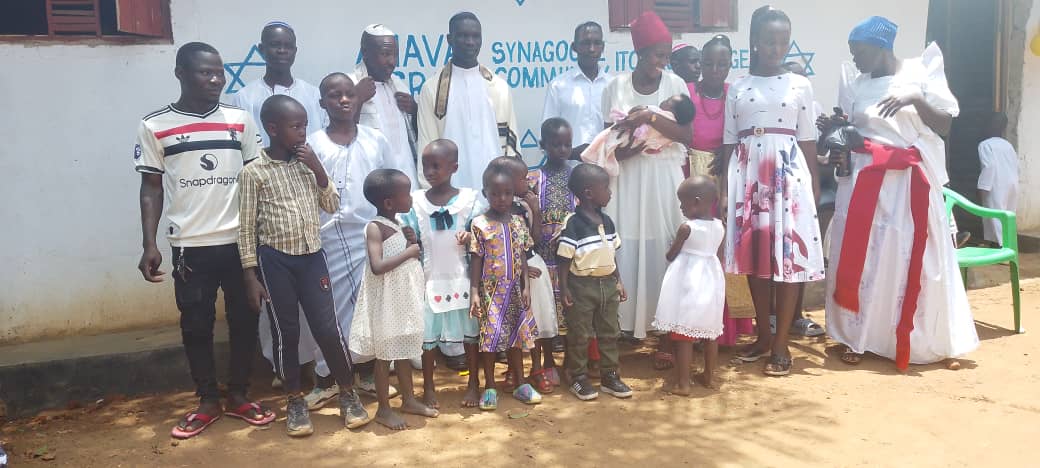
 By Jonathan D. Epstein
Ahavat Yisrael is a synagogue of 65 families and 280 men, women and children in Itonko, a small farming village in Namutumba District of eastern Uganda, about 68 kilometers southwest of Mbale. The members used to walk a long distance to a synagogue in another community to pray, but it became too far. So they formed their own in 2010, with elders, youth and teenagers. They pray, they study, they observe customs and mitzvot, and they support Israel. But they need help to support their Jewish growth and sustain their community. 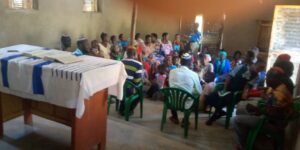
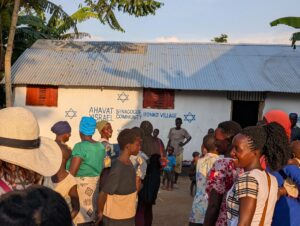 FJMC visited Ahavat Yisrael on our last trip to Uganda in December 2024, and were greeted with open arms, hugs and dancing. We gathered with the congregation inside their synagogue. We heard from their spiritual leader and lay leader, sang, and talked to each other.
 “Our shul is a simple building with mud walls and an iron sheet roof. But to us, it is everything,” said Isaac Kiiza, president of Ahavat Yisrael Jewish Community. “It is our house of tefillah, our school for Torah and Hebrew, and the center of our village life. On Shabbat, all 65 families come together. The children learn, the adult pray and we feel like one family.”
But the roof started leaking three years ago, and water came inside during the rainy season. They’ve had to put buckets inside, and could not daven sometimes when it rained too hard. The iron sheets became rusty, and the timbers weakened. A few months ago, the roof and walls were severely damaged by heavy rains, causing the roof to collapse, while community leaders fear the walls will be next.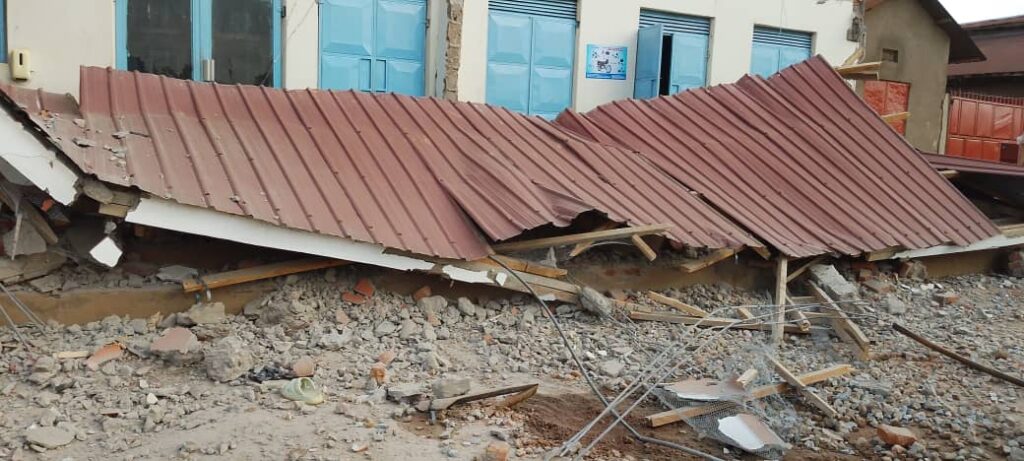

The families now hold Shabbat and daily prayers in a small rented room that also leaks and has unsafe wiring. But they want to repair and return to their shul.
“Without the shul, we would lose our connection to Judaism and to each other,” Kiiza said. “Children cannot learn Torah properly when it rains. Torah scrolls and siddurim get wet and can be damaged. People are discouraged to come at night or in rainy season.”
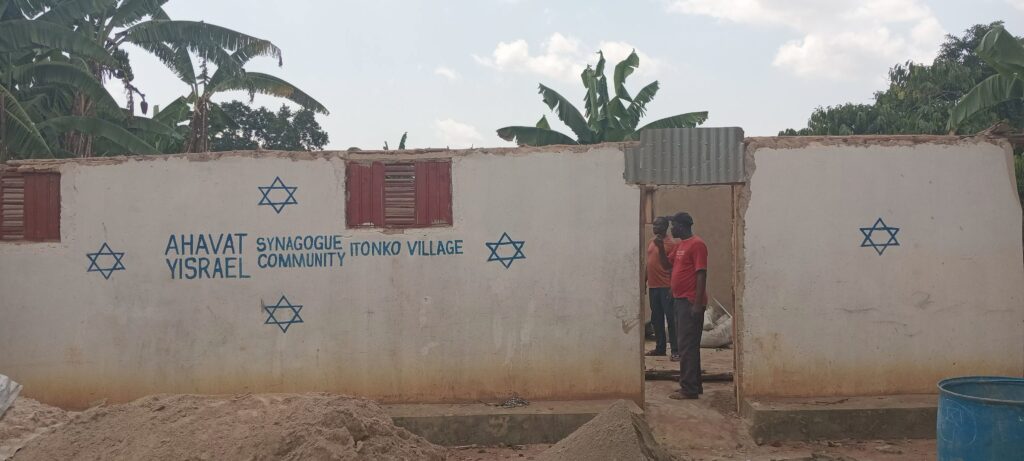 An engineer assessed the damage and prepared a plan to repair the roof, reinforce the walls, fix the floor and make it safe. The cost is $2,500, for new iron sheets, timbers, cement, two doors, labor and transportation. “This is the most urgent need so our shul is safe and dry,” Kiiza said.
Longer term, he added, they hope to add solar panels and lights, a generator, and a projector, screen and cables, so they can hold night prayers and Torah classes. That’s another $1,621.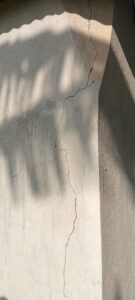
Then there are other needs. The community is seeking siddurim, chumashim and children’s Hebrew books; a sefer Torah scroll; benches and tables for the children while studying, and financial support for a rabbi and teachers. And they want to observe kiddush every Shabbat but can’t afford to buy kosher wine or ingredients to bake challah.
“Whatever Hashem puts on people’s hearts, we are grateful for,” Kiiza said. “We would like to be learning more about Judaism on Shabbat after service.”
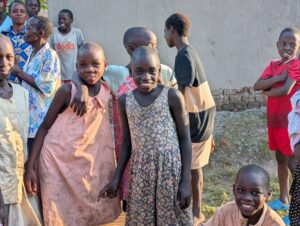 Finally, they are considering a small-scale chicken farm project, to grow chickens for both eggs and meat, as well as for sale to raise money for the shul to buy books, pay the rabbi and maintain the building. Donors can help sponsor the project by purchasing the birds or materials. Under current prices in Uganda, day-old chicks are just 95 cents each or $190 for 200 chicks, while a grown hen for eggs is $6.75 each and a rooster for meat is $8.10 each. The goal is to get enough hens to lay 150 eggs per day, with half to be sold and half used to feed the children in the shul. A full project to start a farm, including chicken feed, the chicken coop, vaccines, waterers and feeders, would run just over $1,100.

Most of all, though, he said the community desires a connection, “to feel that we are part of the global Jewish family.”
That’s what FJMC is all about.
Jonathan D. Epstein is co-chair of FJMC International’s Abayudaya Initiative with FJMC International Vice President Bob Watts, and is also Vice President of FJMC’s new International Region and Editor of HaD’Var.
Need technical or website help? Email us at
Copyright © 2026 FJMC International. All rights reserved. Website designed by Addicott Web. | Privacy Policy