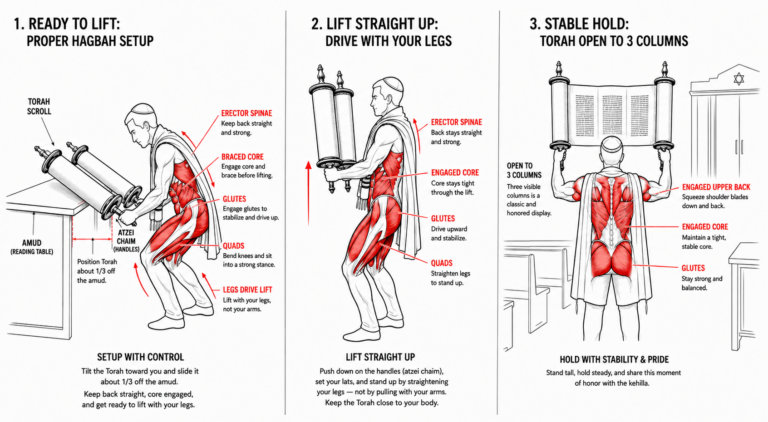
Brace before you move. Everything starts with a strong, stable core, and hagbah is no different. Right before you lift, exhale fully — truly completely — and feel the lower part of your abdomen tighten. Hold that tightness. You can breathe normally after that, but keep the brace engaged through the whole lift.
Set the Torah up for success. While it’s still on the amud (reading table), arrange the columns you want visible — three to five is generally a good number — and roll each side to take out any slack in the scroll. You don’t want any surprises once you’re mid-lift.
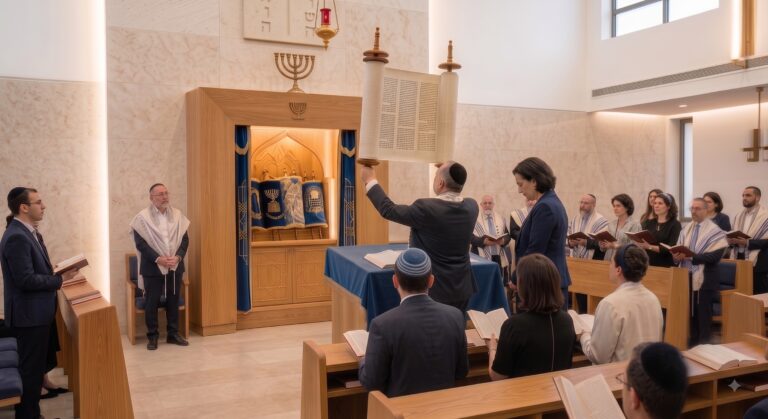
The lift itself. Cindy’s preferred method: slide the Torah at least halfway off the amud, bend your knees, keep your back straight and your core locked in, then push down on the handles (atzei chaim), set your lats, and straighten your legs. In short — get underneath the Torah and lift with your legs while your upper body stays locked in place, not swinging or arcing the scroll up with your arms.
Cindy’s pro tip: talk to your golel (the person doing gelilah) ahead of time — even a quick sentence right before you lift works. Something like, “Grab the top handle as soon as I sit down and start rolling the scroll closed.” It’s a small thing, but it matters, especially if your golel hasn’t done this before.
One more note from Cindy: the mechanics aren’t identical for everyone. Men can widen their stance and rest the Torah against their legs as they settle into the chair; women in a dress that isn’t floor-length often can’t do the same and need to plan for that difference ahead of time.
None of this requires a gym membership. With a little practice, it’s an honor most of us can perform with confidence and pride for the holidays, and all year round.
For more on the ritual and techniques, see the International Kiddush Club page on Hagbah, which also includes a link to Past International President Stan Greenspan’s FJMC “Hagbah and Gelilah – a guide to properly lift, separate and tie“.




 Written by Bob Watts,