




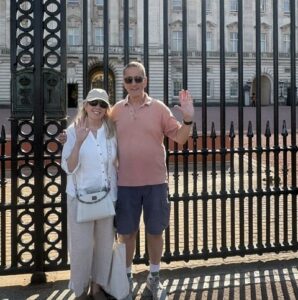
 This summer, my wife and I traveled to London and Belgium. It was a trip I had anticipated for years, but I also began it with mixed emotions.
Like many Jews, I have watched with growing concern the rise of antisemitism across Europe in the aftermath of October 7. News reports of anti-Israel demonstrations, attacks on Jewish institutions, and increasing hostility toward Jewish communities made me wonder what it would actually feel like to travel there as an openly proud Jew and committed Zionist.
Belgium, in particular, held special meaning for me. It was the one country in Europe I had never visited where my father had once lived as a young man. I hoped to walk streets he once knew, to experience the places that formed part of his childhood, and perhaps feel some connection to the Europe my parents remembered before the Holocaust forever changed Jewish life on that continent.
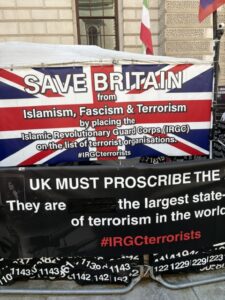 London was everything I had hoped it would be — a magnificent city filled with history, culture, and remarkable diversity. Before arriving, I had been aware of its large Muslim population simply because so much has been written about changing demographics and the tensions surrounding Israel and the Jewish community. Yet throughout our stay, I never felt threatened or unwelcome. We visited historic sites, museums, and neighborhoods throughout the city, and I left London feeling encouraged that perhaps my concerns had been greater than the reality.
There is no denying the beauty of Brussels, Bruges, Ghent, and Antwerp. Their architecture, history, and charm are extraordinary. But beneath that beauty, I found myself increasingly uneasy.
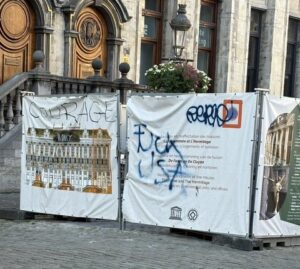 The demographic changes were immediately apparent, particularly in Brussels, where large Muslim communities are now an unmistakable part of the city’s fabric. By itself, that observation would not have troubled me. What unsettled me was the atmosphere surrounding it. I encountered numerous “Palestine” shops and signs, anti-American graffiti — including “F the USA” — and an environment that made me increasingly conscious of being Jewish. Whether those feelings were entirely justified or simply reflected the times in which we live, they were real, and they remained with me throughout our visit.
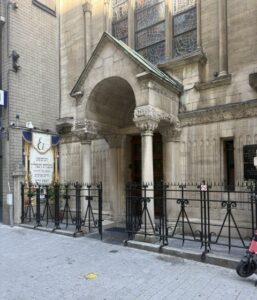 The moment that affected me most came in Antwerp’s historic diamond district. It was Sunday, so the streets were relatively quiet, but standing outside the Sephardic synagogue were two heavily armed soldiers carrying military-style rifles. Their presence was reassuring because they were there to protect the Jewish community. Yet at the same time, it was heartbreaking.
Perhaps the most emotional experience of the trip was reconnecting with the children of my father’s childhood friend — a man who survived the Holocaust by hiding from the Nazis during the war.
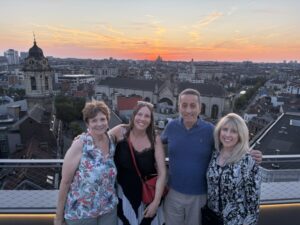 Meeting them was deeply meaningful because they represented a living connection to my father’s past. Yet I left saddened by something I had not expected. Their connection to Judaism had largely disappeared. They were warm, gracious people, but Jewish identity no longer seemed to play a meaningful role in their lives. It struck me that the Nazis failed to destroy the Jewish people, but over generations, assimilation and disconnection have quietly accomplished what persecution could not. That realization affected me more than I can adequately express. As I reflected on our journey home, I realized I had gone searching for my father’s Europe. Instead, I found a continent where many Jewish communities continue to persevere with courage but often behind security barriers, where Jewish identity can feel increasingly vulnerable, and where too many families have become disconnected from the traditions and values that once defined them.
The experience reinforced something that speaks directly to the mission of FJMC International.
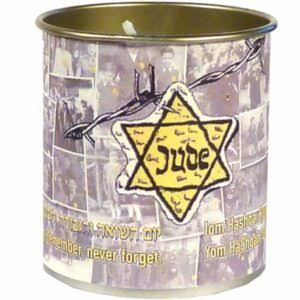 Every Men’s Club gathering, every mentoring relationship, every Yellow Candle we light, every father, grandfather, or friend who helps another Jewish man deepen his connection to Judaism — these are not simply programs. They are acts of continuity. They are investments in ensuring that future generations remain proudly connected to their heritage, their community, and the State of Israel. We certainly face serious challenges here in the United States, and antisemitism is something we must never dismiss. But after seeing what I experienced in Europe, I returned home with an even deeper appreciation for this country and the extraordinary opportunity we still have to live openly and proudly as Jews.
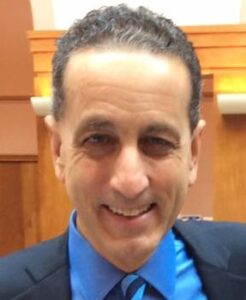 Danny Mandeau
Appointed Member
FJMC International
Excutive Comittee 2025-2027
www.fjmc.org
Need technical or website help? Email us at
Copyright © 2026 FJMC International. All rights reserved. Website designed by Addicott Web. | Privacy Policy