

How Do We Come To Religion Or Spirituality?
by Al Davis
How do we come to religion or spirituality? I’m not certain. Some say it’s genetic wiring, others say it’s nurturing and training. I’ve seen siblings — same sex and opposite sex — even twins — raised in the same household with the same upbringing, the same exposure to things religious and spiritual, all go in different directions. About my sister and me, my father always said, “I raised one very much on the religious side and one who’s Judaism was very limited to cultural appreciation.
When I think about my ties to religion, my mind travels decades back to a bungalow in Kiamesha Lake, New York. There, every weekday morning, when my zeyde finished davening Shacharis, he’d wrap his 2 ½-year-old eynekel (grandson) in his tallis and teach him “modye anye,” what we’d pronounce as Modeh Ani. After that, we’d work on Birchat Ha-shachar. It would be many years before I learned to pronounce the word ‘baruch’ instead of ‘bureekh.’ That, and several other pronunciational artifacts make me tear up when they are called to mind. Being honest, if I daven while still farshluffen (sleepy), some of Zeyde’s pronunciations spill out of my mouth.
Genetics or not, the nurturing aspect began there. It continued at home where, every Friday night Mom lit the Shabbos candles on the stove in our tiny apartment kitchen. I can close my eyes and see her don the tikhel (like a kerchief) on her head, light the candles, wave the light to her eyes and then cover them as she prayed. I was spellbound. Sometimes the prayers were quick, but other times she lingered over her likhte. She never shared whatever was on her mind or heart those times, but even as a pitzele, I understood that this was sacred time to her.
Every Yom Tov was a special occasion. In the early years, Seders were always at Bubby and Zeyde’s house. A long table took up the whole living room, eleven people squeezed around it. My sister and I had two very special cups that managed to find their way to America from the old country, one of which I still have. At over 130 years old, it has unimaginable value and it graces my Seder table still. The smells and the davening, the lilting of Dayenu and Ki Lo No-eh, Ki Lo Yo-eh, my mother, aunt and Bubby walking down the very long hallway to open the door for Eli Hanovi, all of these play on the back of my mind.
No one traveled on the High Holidays, but every Rosh Hashana and Yom Kippur would find me in shul wrapped in the tallis of my godfather, Wolfe Rosenblatt. At shofar time, I was lifted up to see where these magical sounds came from. I was in awe.
It was also at the age of seven that Mom began reading to me at bedtime from a book called A Children’s History of Israel by Sulamith Ish Kishor. This was volume 1 of what I would much later learn was a full set. Book one was actually a children’s version of the Torah. Night after night she read and quizzed… and I lapped it up. Who needed Disney stories? As Chanukah approached that year, Mom got a book that would teach the Hebrew alphabet, the Aleph-Bet, and basic words formed from the letters and vowels.
When I was a toddler on Macombs Road in the Bronx, Dad would always introduce me to friends and neighbors with the words, “Dos iz mayn Kaddishl.” For those who don’t speak Yiddish, Dad introduced me with what was then (and probably remains so, in some circles) a term of endearment for a son who would eventually be the one to say Kaddish for you. As a pitzele, I only understood the term as one of endearment. When I was old enough to understand the full context, I grew to hate the term (but never said anything). Now, as an adult, when I finish Kaddish or Yizkor for him, I look up and say, “Your Kaddishl is on the job.” Forgive me as I take a second to wipe away a few tears.
At the age of 12, Seder suddenly became my responsibility. Zeyde was failing and hospitalized, and Dad wasn’t able to take over. As leader of the Seder, I insisted that my cup be filled with wine. Wine…Shapiro’s Extra Heavy Malaga, which was like wine-flavored Jello in a cup — almost thick enough to cut with a knife, but oh so delicious to a child’s palate. Four cups later, and just after finishing “Chad Gadya” and “Eliyahu Hanovi” this 12-year-old retired to the couch and went directly to sleep — no passing “Go!” and without collecting $200.
After Bar Mitzvah, I thought I had enough. Except for holidays, I stayed away for almost a year. But I couldn’t do it. The “Pintele Yid” (the Jewish spark) had been ignited. After leading my third Seder, I went back to shul, joining our Teen Congregation. I soon became it’s Baal Musaf for Shabbos and graduated to the position of Baal Musaf for Rosh Hashana and Yom Kippur. When I wasn’t in Teen Cong, I was downstairs listening to the Chazzan’s High Holiday nussach and melodies. Once in college, I returned every High Holiday season to sing in the choir. A natural baritone, Cantor Burger had me singing first tenor.
After marriage and a move to New Jersey I quickly became the Shaliach Tzibur (service leader) for P’sukei D’zimra, Shacharit, or Musaf — sometimes all three. At the age of 35, I decided that I needed to learn how to read from the Torah — to leyn. A rabbi I worked with, gave me the basics. “Learn the Ivrit, the sofey pasuk, and then worry about the trope. Start by leyning the maftir reading. this is usually three or four sentences; five, on occasion.” I read about a dozen portions this way, but was unsatisfied not being able to chant. So, I bought a tape and learned the trope. Long story short, I now leyn every Shabbos, and I can visualize Zeyde’s neshama (and Mom & Dad’s) shepping naches from it all.
After my son and his friends celebrated their b’nai mitzvah, I realized they were very unhappy in shul. They were old enough, and in fact required, to participate in services, but services were aimed at the older adults. Aliyot were given to the adults. Remembering what I had as a teen, with the rabbi’s blessing, I created a teen congregation — a service of the teens, for the teens, and by the teens.
Especially for those of us who are retired and don’t have to worry about commuting, being part of the morning minyan and enjoying breakfast and a l’chaim after davening, along with all manner of conversation is a great way to start the day. This is stress-free religious practice, with built-in socialization, six days a week. Of course, many Sunday morning minyanim are followed by a wonderful Men’s Club program.
Could I have foreseen any of this on those early mornings in Kiamesha Lake under Zeyde’s tallis saying “Modye Anye?” No. But I thank him profusely for kindling and nurturing that “pintele Yid” inside me — and my parents, as well.
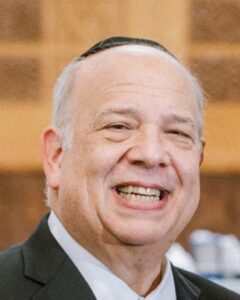 Written by Al Davis
“How Do We Come To Religion Or Spirituality?” published in the Fall 2026 Edition of Health & Wellness, L’chaim.
Need technical or website help? Email us at
Copyright © 2026 FJMC International. All rights reserved. Website designed by Addicott Web. | Privacy Policy


