





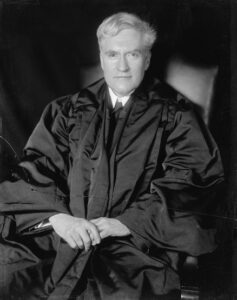
 In that regard, we focus here on Benjamin Cardozo, best known as the second Jewish U.S. Supreme Court Justice, who served from 1932 to 1938. (Brandeis was the first.) He was also the first Sephardi Jew— he was descended from Portuguese conversos (Jews who converted to Catholicism during the 14 th and 15 th century Inquisition rather than be persecuted or killed) who emigrated to Holland and re-adopted their Judaism. His ancestors came to America before the American Revolution.
Cardozo made his greatest impact on American law before his Supreme Court service through his writing on the law, especially his classic work The Nature of The Judicial Process (1921), and through his innovative decisions on contract and tort law while serving on the New York Court of Appeals, the state’s highest court.
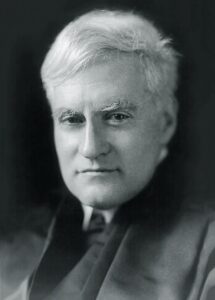 Cardozo made a forthright assessment of what judges do and what their role should be. Rather than treating judges as interpreters of sacred canons, Cardozo stated that at times, a judge’s job is to make new law. When confronted with a case where the law is silent or where its strict application would be unjust, a judge must balance legal principles, logic, tradition, and considerations of reason, justice, utility, and social welfare. Cardozo was not a judicial activist—he believed judges should never strike down a law unless it is; so plainly arbitrary and oppressive that right-minded men and women could not reasonably regard”] it otherwise. He also believed that in considering justice and social welfare, judges must look to community standards rather than to their own personal values.
Cardozo’s decisions in the below civil cases demonstrate his commitment to deeply held Jewish values.
Some examples:
Schloendorff v. Society of New York Hospital (informed consent from a patient before operation)
MacPherson v. Buick Motor Co. (manufacturers’ product liability)
Wood v. Lucy, Lady Duff-Gordon (implied promise of good faith performance in a
contract)
Jacob & Youngs v. Kent (no right to terminate a contract that was substantially performed)
Wagner v. International Railway (the Rescue Doctrine: a wrongdoer who places someone in peril is also legally liable for injuries sustained by a third-party rescuer)
Meinhard v. Salmon, 164 N.E. 545 (1928) (business partners owe a fiduciary duty to each other)
Resource: David Rozenson sourced from Wikipedia article and sources cited therein.
Resource: Images used above for Benjamin Cardozo are in the public domain.
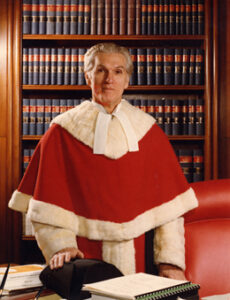
Bora Laskin was born in Fort William (Thunder Bay), Ontario, on October 5, 1912. He was the son of Max Laskin and Bluma Zingel. After graduating with a B.A. from the University of Toronto in 1933, he enrolled at Osgoode Hall Law School. From 1933 to 1936, he served his articles and continued to study at the University of Toronto, earning an M.A. in 1935 and an LL.B. in 1936. The following year, he received an LL.M. from Harvard Law School. Upon his return to Toronto that year, he was called to the bar and began his legal career writing headnotes for The Canadian Abridgement. In 1940, he embarked on a teaching career that spanned 25 years, mostly at the University of Toronto except for four years at Osgoode Hall (1945-49). He was the author of many legal texts, including Canadian Constitutional Law, and was associate editor of Dominion Law Reports and Canadian Criminal Cases for 23 years. He was appointed to the Ontario Court of Appeal in 1965 and to the Supreme Court of Canada on March 19, 1970. On December 27, 1973, he was named Chief Justice of Canada. He served on the Supreme Court for 14 years. Chief Justice Laskin died on March 26, 1984, at the age of 71.
Photo Credit: Supreme Court of Canada.
Need technical or website help? Email us at
Copyright © 2026 FJMC International. All rights reserved. Website designed by Addicott Web. | Privacy Policy