



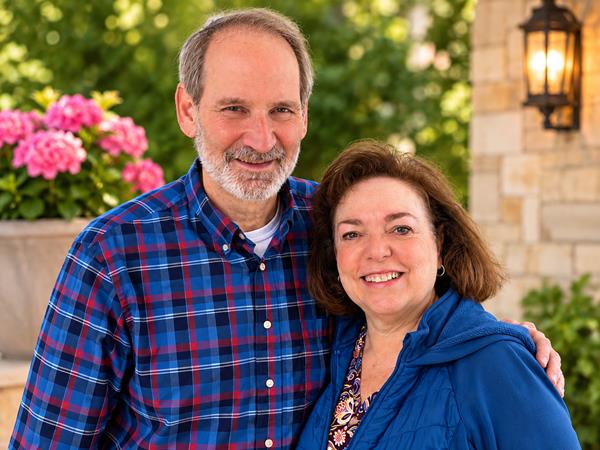
What does it mean to be a mentor? For Scott and Susan Shikora, it means more than teaching skills or helping someone advance professionally. It means building connections, sharing values, creating opportunities, and making the world better for those who follow.
Although their experiences differ, Scott and Susan share a fundamental belief: We have a responsibility to pass along what we have learned and help the next generation succeed.
For Susan, that commitment is rooted in Hadassah, an organization that has been part of her family for generations. Connecting Israel, Judaism, and healthcare, Hadassah brings people together around shared values. As a national leader and presidential development co-chair, Susan helps prepare future leaders, working with regional presidents nationwide to preserve the organization’s knowledge, experience, and traditions.
But mentorship goes beyond organizational training. For Susan, it means sharing the experiences that make Jewish leadership meaningful and understanding what it means to be a Jew, a Zionist, and a leader today. She carries forward the wisdom of those who shaped her journey.
Susan is the fourth of six generations of Hadassah members in her family. Her great-grandmother, grandmother, and mother established that connection, which continues through her children and grandchildren. Her three-year-old granddaughter is already a Hadassah life member! Mentorship, for Susan, extends the bonds of family across generations.
Scott’s mentorship experience comes from medicine, particularly bariatric surgery. He has trained more than 30 young surgeons, many now leaders in their hospitals and practices. They, in turn, train others. Scott describes this as a family tree, with knowledge branching from one generation of surgeons to the next.
Surgeons often say, “See one, do one, teach one.” While this captures hands-on learning, Scott believes effective mentorship requires patience, empathy, and recognition that trainees will become skilled professionals themselves. Beyond teaching surgical techniques, mentors help develop confidence and judgment.
The rewards can be extraordinary. Scott describes unexpectedly encountering surgeons he trained years earlier, hearing about their careers, and realizing how far those teaching relationships have traveled. What began as sharing knowledge has grown into something much larger.
Scott, a former president of the Temple Israel, Sharon, MA Brotherhood and proud FJMC International member, sees strong parallels with Judaism. Jewish life centers on teaching across generations. Parents pass along traditions, communities prepare young people for responsibility, and even our Hebrew names connect us to our parents and those who preceded us.
This brings us to L’dor V’dor, from generation to generation, a Jewish value underlying both Scott’s and Susan’s work. We are part of an ongoing story, inheriting knowledge, traditions, and responsibilities that we must share with those who follow.
Another guiding value is Tikkun Olam, repairing the world. Susan supports Hadassah’s hospitals and healthcare mission in Israel while developing future leaders. Scott trains surgeons who care for patients, teach physicians, and improve healthcare. Both recognize that making a difference involves not only what we accomplish, but what we enable others to accomplish.
Perhaps Scott captured mentorship best when reflecting on what he hopes his children learn from watching him and Susan: “It’s not all about me. It’s not all about you. It’s about everybody that you can help.”
That may be the most important lesson. Mentorship doesn’t require a formal program or title. It begins with sharing knowledge, offering encouragement, opening doors, and leading by example. As Scott reminds us, talk is cheap. What matters is how we live and what others learn by watching.
Whether in hospitals, synagogues, community organizations, or families, each of us has something to teach and give. The impact may not be immediately visible, but it grows as those we mentor help others.
That is mentorship’s beauty. It completes the circle, connects generations, and reminds us that the best way to honor those who helped us is to do the same for someone else.
L’dor V’dor. From generation to generation.
Need technical or website help? Email us at
Copyright © 2026 FJMC International. All rights reserved. Website designed by Addicott Web. | Privacy Policy